



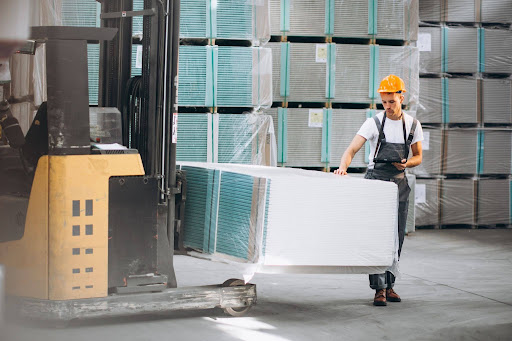
A panel lifter is a specialized mechanical or manual tool that enables a single person to safely lift, hold, transport, and stack large, flat, heavy materials. It is most commonly used in incineration and reception projects to handle sheet goods such as drywall, plasterboard, plywood, OSB, insulation, and glass.
By handling the heavy lifting and holding, these tools turn difficult multi-person installations into smooth, single-person jobs while drastically reducing back strain and the risk of injury. Have you been wondering about panel lifters and what other types there are? Then you are just in the right place. In this panel lifter guide, we will discuss the four main types of panel lifters and the benefits of each.
Mechanical Drywall Lifts (Hoists)
Mechanical drywall lifters, also known as hoists, are among the most common panel lifters. They are large, wheeled steel frames equipped with a cradle and a manual crank or winch. They work by placing a sheet of drywall or plywood on the cradle, tilting it to the desired angle, and cranking the winch to raise it flush against a ceiling or wall.
They also feature extendable outrigger arms to stabilize sheets up to 16 feet long, a built-in braking system to prevent the load from slipping, and tripod caster bases for easy mobility across the floor. A common industry-standard lifter is the Panellift 138-2, and a more budget-friendly DIY option is the Franklin 150-lbb. Capacity Hoist.
Foot-Operated Pocket Lifters
Foot operators are another common type of panel lifter. These lifters are used for minor vertical adjustments at floor level. They work when you slide the tapered metal lip beneath the bottom edge of a wall panel resting on the floor, press down on the appropriate foot, and, with your foot pivoting, raise the panel a few inches.
They keep your hands completely free so you can align the panel with the wall studs and fasten it with screws or nails.
3. Handheld Suction & Vacuum Lifters
Handheld suction and vacuum lifters (chrome) are used in business for nonporous sheet surfaces, such as heavy glass panels, sheet metal, solar panels, or raised data-center flooring tiles, when mechanical clamps won’t work.
These lifters use manual suction cups or a motorized industrial vacuum system to securely grip the material’s smooth surface. They also feature long-handled models that allow data center technicians to lift floor panels from a standing position, avoiding constant bending.
4. Manual Panel Carriers (Trolls)
The manual panel carrier doesn’t raise or lower the shutters, but these compact dollies are designed solely to move heavy sheets around a job site. They work by dropping the edge of one or two heavy boards into small steel C-clamps mounted on rubber wheels, using a handle to slide the load comfortably.
Benefits of Using Panel Lifters
Panel lifters transform demanding multi-person installations into safe, single-person tasks. By handling heavy lifting and holding, they drastically reduce back strain, fatigue, and the risk of workplace injuries. These tools protect expensive materials from accidental drops while maximizing job site efficiency, saving you significant time, labor costs, and physical effort.